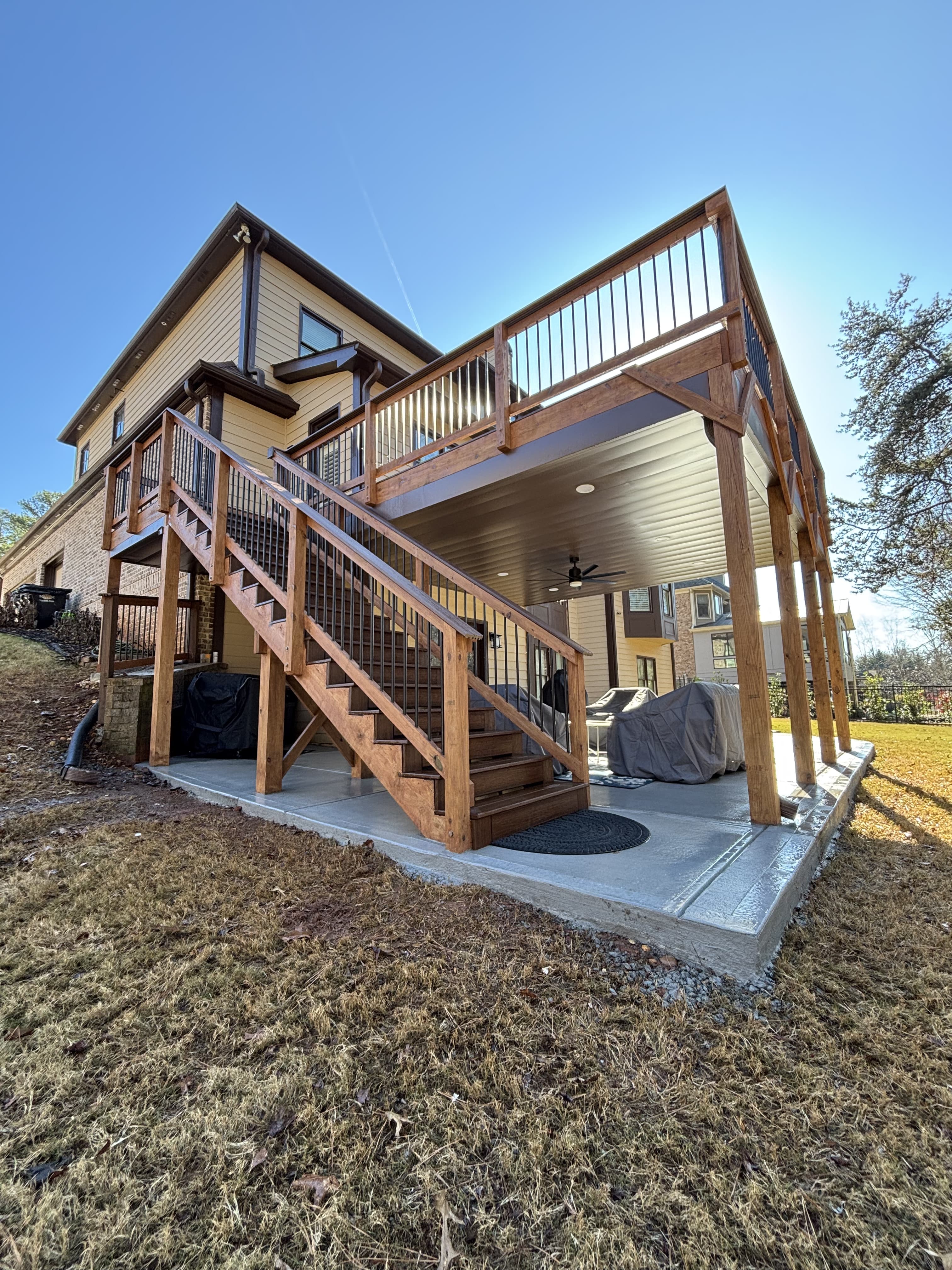
Your deck has seen better days. The boards are graying, a few feel soft underfoot, and you're wondering: should I repair it or tear it down and start fresh? For Atlanta homeowners, the answer depends on structural integrity, repair costs, and your long-term plans. Here's how to make the right decision.
Warning Signs Your Deck Needs Attention
Atlanta's humid climate, intense UV exposure, and seasonal temperature swings accelerate deck aging. Here are the warning signs to watch for:
Structural Red Flags (Replace)
- Soft or spongy boards: Insert a screwdriver into suspect areas. If it penetrates more than 1/4 inch, the wood has rotted.
- Wobbly posts: Posts should be rock solid. Any movement indicates rot at ground level or failed footings.
- Sagging or bouncing: Structural members (joists, beams) may be compromised if the deck bounces when you walk or visibly sags.
- Widespread rot: If rot affects more than 25-30% of the deck boards, replacement typically makes more financial sense.
- Ledger board damage: The ledger (attached to your house) is critical. Any rot, separation, or water damage here is a safety hazard.
Cosmetic Issues (Repair)
- Surface graying: Sun-bleached wood is purely cosmetic. Power washing and staining restores appearance.
- Minor cracks/splits: Small surface cracks in individual boards can be replaced without touching the structure.
- Loose fasteners: Popped nails or loose screws are normal wear. Replacing with longer screws is a quick fix.
- Worn stain/sealant: Faded or peeling finish just needs stripping and reapplication.
- A few damaged boards: Replacing 5-10 boards is straightforward and cost-effective.
The Structural Inspection
Before deciding on repair vs. replacement, perform (or hire someone to perform) a thorough structural inspection. Here's what to check:
1. Ledger Board Connection
The ledger board attaches your deck to your house and carries half the deck's load. Check for:
- Proper flashing above the ledger to prevent water infiltration
- No gaps between the ledger and house siding
- Secure lag bolts (not just nails) into the rim joist
- No signs of rot, especially at bolt locations
2. Posts and Footings
Posts should sit on concrete footings that extend below the frost line (12 inches in Metro Atlanta). Look for:
- Posts that are plumb (straight up and down)
- No rot at the base where posts meet concrete
- Secure post-to-beam connections
- No heaving or shifting of footings
3. Beams and Joists
These horizontal members support the deck boards. Inspect for:
- Cracks, splits, or checking (deep surface cracks)
- Sagging between supports
- Rot at joist ends or where they meet the ledger
- Secure joist hangers with all nail holes filled
Deck Repair vs Replacement: Cost Comparison
Here's what Atlanta homeowners typically pay for deck repairs vs. full replacement in 2026:
Typical Repair Costs
- Board replacement: $8-15 per board (pressure-treated) or $20-40 per board (composite)
- Post replacement: $200-400 per post including footing
- Railing replacement: $20-50 per linear foot
- Stair rebuild: $300-800 depending on length
- Power wash and stain: $2-5 per square foot
- Structural repairs: $500-2,500 depending on extent
Full Replacement Costs
- Pressure-treated pine deck: $25-40 per square foot
- Composite deck (Trex, TimberTech): $40-65 per square foot
- Hardwood deck (Ipe, mahogany): $50-80 per square foot
- Demolition and disposal: $1,000-2,500 for typical deck
The 50% Rule
A general guideline: if repair costs exceed 50% of replacement cost, replacement usually makes more sense. You get a brand-new deck with modern materials, updated design, and a fresh warranty instead of patching an aging structure.
When to Repair Your Deck
Repair makes sense when:
- Structure is sound: If posts, beams, joists, and ledger are in good condition, you only need to address surface issues.
- Deck is less than 10-15 years old: A well-built pressure-treated deck should last 15-20+ years with maintenance. If yours is younger and the structure is solid, repair is worthwhile.
- Limited damage: Replacing a handful of boards, tightening connections, and refinishing is cost-effective.
- Budget constraints: Sometimes repair buys you time while you save for a full replacement.
- You're selling soon: If you plan to sell within 1-2 years, cosmetic repairs may be sufficient.
When to Replace Your Deck
Replacement makes sense when:
- Structural issues: Rot in posts, beams, joists, or the ledger compromises safety. Don't patch structural problems.
- Age: Decks over 20 years old built with older construction methods may not meet current codes.
- Code compliance: Older decks often have inadequate railings, improper ledger attachment, or missing footings. Bringing up to code may cost as much as replacement.
- Design changes: If you want to expand, change layout, or add features like built-in seating or a pergola, starting fresh is often easier.
- Material upgrade: Switching from pressure-treated to composite requires new framing to accommodate different spans and fastening.
- Repair costs exceed 50%: See the 50% rule above.
Atlanta-Specific Considerations
Several factors unique to Metro Atlanta affect the repair vs. replace decision:
Humidity and Rot
Atlanta's humidity accelerates wood decay. Pressure-treated lumber resists rot better than untreated wood, but no wood lasts forever in our climate. Decks on the north side of homes or shaded by trees rot faster due to retained moisture.
Termite Damage
Georgia has significant termite pressure. If your inspection reveals termite damage in structural members, replacement is typically necessary. Termite damage often extends beyond what's visible.
Building Codes
Cobb, Cherokee, Fulton, and Gwinnett counties all require permits for deck construction. Significant repairs may trigger permit requirements and code inspections. If your existing deck doesn't meet current code, you may be required to upgrade during permitted repairs.
Get a Professional Assessment
When in doubt, get a professional inspection. A reputable deck contractor will honestly tell you whether repair or replacement makes sense for your situation. Be wary of contractors who push replacement regardless of condition—or those who want to patch obviously failing structures.
Free Deck Inspection
Not sure whether to repair or replace? We'll inspect your deck and give you an honest assessment with repair and replacement options.
Schedule Your Inspection